
Key takeaways
- Every format here is script-first, so an AI illustrated video tool builds the visuals, voice-over, and edit for you — no face, no filming, no timeline.
- The hook in the first 1–2 seconds and retention across the rest decide whether a short performs; each of the 21 ideas is built around a strong opening line.
- Batching turns the real bottleneck (production, not ideas) into an afternoon: seven scripts become seven finished videos in under an hour.
Pick a few faceless formats from the list below, write short scripts, and turn each one into a finished video you can post on repeat across all three platforms.
Here are 21 AI short form video ideas you can run on TikTok, Reels, and YouTube Shorts without a camera. Every format is script-first, so an AI illustrated video tool can build the visuals, voice-over, and edit for you. Pick a few, write short scripts, and post on repeat.
The hard part of short-form was never the camera. It's the blank page. You sit down to post, stare at the app, and nothing comes. Even when you do have a thought, setting up lights, filming, and editing kills it before you start.
This post fixes the first problem with a list of AI short form video ideas that work, and the second by showing how to turn any of them into a finished video from a script. No face, no filming, no editing timeline. These formats run on TikTok, Instagram Reels, and YouTube Shorts on repeat, and most get stronger the more you post.
Pick three or four formats from the list, then read the production section to see how to ship a week of them in an afternoon.
What makes a short-form video stop the scroll
Two things decide whether a short-form video works: the hook in the first 1–2 seconds and retention across the rest. A strong hook earns the watch, and tight retention keeps viewers to the end. Get both right and a mediocre idea outperforms a great one with a slow open.
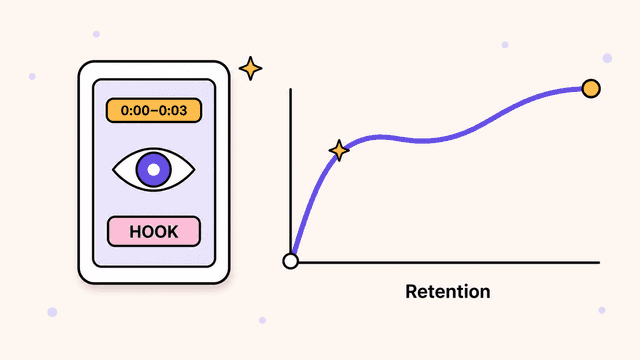
- The hook is the first 1–2 seconds. On TikTok, Instagram Reels, and YouTube Shorts, viewers decide to stay or swipe almost instantly. Lead with the most surprising line, a direct question, or a bold claim. Never a warm-up. "Did you know honey never spoils?" beats "Hey guys, today I want to talk about honey."
- Retention is everything after that. The algorithms reward watch time and completion rate above likes or follows. Every sentence should pull the viewer to the next one. Cut throat-clearing, withhold the payoff until the end, and keep the video short enough that people finish it.
- Add captions and use trending audio. Most short-form is watched on mute, so burned-in captions keep silent viewers reading. Trending audio gives the algorithm another reason to push the clip. Both lift watch time.
- Shoot vertical 9:16. One vertical video fills the screen on all three platforms, so you produce once and post everywhere.
Keep those four in mind as you read the list. Each idea below is built around a strong opening line for this reason.
Faceless short form video ideas that work
These 21 faceless short form video ideas each come with a one-line example and the reason they hold attention. None need your face, a location, or a tripod, so they all start as a script. Steal whichever fit your niche.
"Did you know" facts
A surprising fact that pays off in seven seconds and begs to be shared. "Did you know honey never spoils?"
Myth-busting
Correct a belief the viewer holds and they'll watch to resolve the tension. "You don't need 8 glasses of water a day."
Story time
A personal narrative arc holds attention to the very end. "I almost lost my business over a $40 invoice."
Listicles
A numbered promise tells viewers exactly how long the payoff is. "5 free tools that replace paid software."
Explain a concept
Make a confusing thing clear in under a minute. Saves pile up, and the algorithm loves saves.
Hot takes
A confident, slightly contrarian opinion pulls comments, and comments pull reach.
Before / after
Show the transformation. Contrast is instantly legible and is the whole hook.
Step-by-step how-to
Actionable steps get bookmarked, and a tight sequence is easy to follow with no presenter.
Brand or product story
Business origin stories play like mini-documentaries people binge.
"Things I wish I knew"
Regret framing signals hard-won advice that feels more honest than a tip list.
Comparisons
X vs Y. Anyone weighing a decision will watch to the end to make it.
Common mistakes
Loss aversion is strong: people watch to check they're not the one slipping up.
Reframes
Give an old problem new language and it feels like a small revelation.
Timelines & history
A clear chronology is satisfying and easy to show scene by scene.
"What if" scenarios
A hypothetical whose curiosity only the payoff number can satisfy.
Question + answer
A question in the first frame is the cleanest hook there is.
Process breakdowns
Peek behind a familiar thing, shot by shot. Endlessly watchable.
Definitions made simple
Explain a term with an analogy people can share. "What is an API? Explained with a restaurant."
Trends explained
Help people understand the thing in their feed without doing the reading.
Mini case studies
A concrete result with a number reads as proof, not opinion.
"Underrated" picks
Recommendations build trust and give people a next step after watching.
Notice what these share: every one is a script. No scene needs your face, a location, or a tripod. That's why they're cheap to produce at volume once you have the right workflow, the same approach behind starting a faceless YouTube channel.
How to produce these fast from a short script
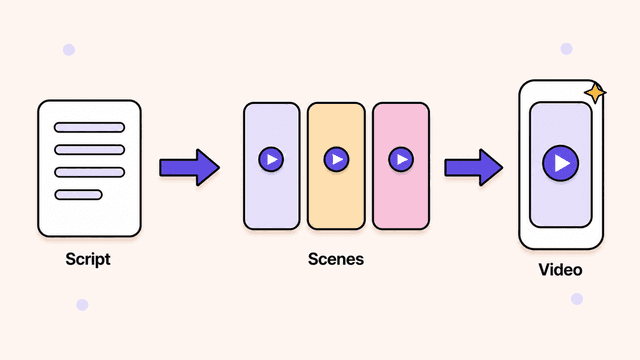
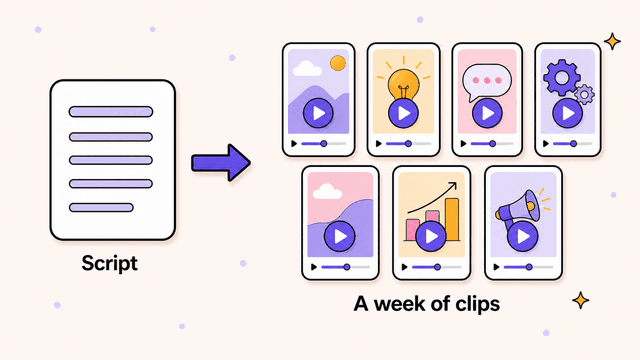
To produce these AI short form video ideas fast, skip filming and write a short script instead, then let an AI illustrated video tool build the visuals, voice-over, and edit. You can draft seven scripts and generate seven finished videos in under an hour. The steps below walk through one video, then a full week.
Here's the bottleneck. You can brainstorm 21 ideas in ten minutes. Filming and editing 21 videos takes weeks. That gap is where most creators quit.
AI illustrated video closes it. Instead of pointing a camera at yourself, you write a short script and let AI build the visuals, voice-over, and edit. The part that makes this work for faceless content: the illustrations are custom-drawn for your script, scene by scene, not generic stock clips you've seen on fifty other accounts.
Skiddee does this. You paste a script, pick a voice and a visual style, and it generates a custom illustration for every scene, adds AI narration and transitions, and assembles the finished video in one click. No design tool, no editing timeline, no recording. It runs as little as ~$1.20 per minute of video on a monthly plan.
The workflow for a single video:
- Write a tight script. For a 30-to-60-second video, aim for 80–150 words. Open with the hook from your idea (the "did you know," the question, the hot take), deliver the payoff, end with a line that earns a follow or a comment. If you want the full breakdown, here's how to turn a script into a video step by step.
- Paste it in and pick a style. Choose one voice and one visual style and reuse them across videos so your account looks consistent.
- Generate and review. Skiddee illustrates each scene, voices it, and combines everything. Because the illustrations follow your actual script, it usually lands on the first try.
- Download and post to TikTok, Reels, and Shorts. Same vertical video works on all three.
This beats stock-footage tools for faceless creators. Stock makes every account look the same, and avatar tools put a fake person on screen that viewers clock instantly. Custom illustrations tied to your words give each video its own look while staying fast and cheap enough to post daily.
Try Skiddee free → Skiddee turns each script into a finished narrated video in minutes. Free to try, no credit card.
A batching workflow for a week of content
Posting consistently is what compounds. Here's how to batch a week in one sitting:
- Pick one theme and one format mix. Say your niche is personal finance. Choose three formats from the list: "did you know" facts, myth-busting, and mini case studies.
- Write seven scripts in one pass. Drafting back-to-back is far faster than writing one, switching to production, then context-switching back. Keep them short. Short on ideas? You can also repurpose blog posts into videos, since each section of an existing post is often a ready-made script.
- Generate all seven in a row. With the same voice and style locked in, each video is paste, click, done. Seven scripts become seven finished videos in well under an hour of active work.
- Schedule across platforms. Drop one a day onto TikTok, Reels, and Shorts. Now you've got a week live and you spent an afternoon, not a weekend.
Do this once a week and you're posting daily without ever touching a camera. The volume is the strategy. More shots on goal means more chances for one to break out and more data on what your audience wants.
Skiddee's pricing fits this rhythm: credits never expire, and the free tier covers about 2–3 minutes of video so you can test a few formats before spending anything. After that there's a one-time $15 prepaid pack for 4,500 credits with no subscription, or monthly plans from $29 if you publish regularly.
Try Skiddee free
Pick a format, write a short script, and let Skiddee handle the visuals, voice-over, and edit. Your first 1,500 credits, about 3–4 minutes of video, are on us — no credit card required.
FAQ
What are the best AI short form video ideas for beginners?
Start with "did you know" facts, listicles, and explain-a-concept videos. They have the simplest structure, a hook then a payoff then a close, so your scripts come together fast, and they perform well on every platform. Once you're comfortable, add story time and hot takes for more reach.
Can I make short form videos without showing my face or filming anything?
Yes. Every idea in this post is script-first, which means an AI illustrated video tool can produce the whole thing from text. You write the words; the tool handles visuals, voice-over, and editing. No camera, no face, no studio.
How long should an AI short form video be?
For TikTok, Reels, and Shorts, 20–60 seconds is the sweet spot. That maps to roughly 50–150 words of script. Shorter videos finish strong and tend to hold a higher completion rate, which the algorithms reward.
How do I keep my faceless videos from looking generic?
Avoid stock-footage tools, since they recycle the same clips across thousands of accounts. Use custom illustrations generated for your specific script so each video has its own look, and lock in one voice and visual style so your account stays recognizable.
Start creating
You've got the ideas and you've got the workflow. The only thing left is to write a script and hit generate. Try Skiddee free and turn your next idea into a finished video before you talk yourself out of it.
About the author
Suyin Kee is Co-founder of Skiddee, an AI tool that turns scripts into illustrated animated videos. She writes about faceless video, creator economics, and AI tooling for educators.