Key takeaways
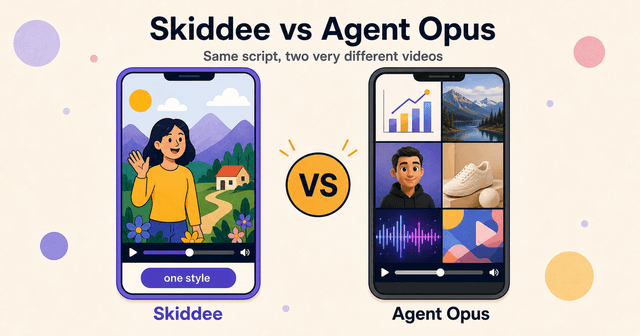
- Both tools turn a script into a finished narrated video, and both will read your script word-for-word. The split is in the visuals.
- Agent Opus is a do-everything social agent: it can research a topic, write the script, and assemble visuals from AI video models, web assets, and motion graphics.
- Skiddee does one thing: custom illustrated videos in a single consistent style. It's breadth versus one deliberate look.
TL;DR: Agent Opus automates the whole social video pipeline, from idea to publish-ready vertical clip, by mixing footage from many AI models with web-sourced assets. Skiddee takes the script you wrote and turns it into an illustrated video where every scene shares one hand-drawn visual identity.
What is Agent Opus?
Agent Opus is OpusClip's AI video generation agent, launched in 2025 at agent.opus.pro. It's a separate product from the OpusClip clipping tool most people know. The clipper chops long videos into shorts; Agent Opus generates new videos from scratch.
You chat with the agent and hand it an idea, a prompt, a script, a link, an audio file, or a blog post. It then runs the whole pipeline itself: research, scriptwriting, storyboard, visuals, motion design, AI voiceover, and editing. For visuals it aggregates several AI video models (Kling, Veo, Runway, Sora, Hailuo, Seedance, Luma, Pika), adds motion graphics with captions and icons, can drop in an AI avatar, and pulls assets from the web. OpusClip's own pitch is that it "turns the entire web into your visual library."
The output is short-form vertical video aimed at social feeds, billed in 10-second increments at roughly 100 credits per minute. There's a full editor afterward, brand asset uploads, and voice cloning on paid plans.
It's an ambitious product, and the automation genuinely goes further than ours. Skiddee won't research a topic for you, won't scrape the web for footage, and won't post to your socials. You bring the script. So the honest question is what happens after the script exists, and that's where the two tools diverge.
What's the difference between Skiddee and Agent Opus?
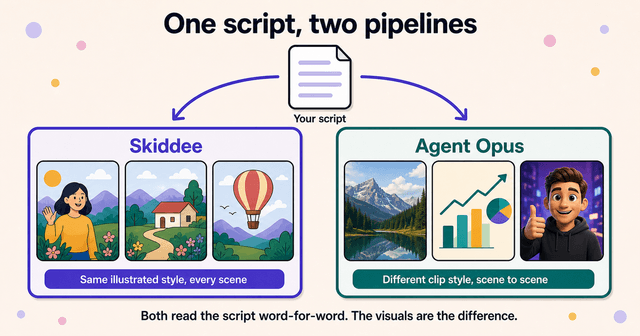
The short version: Agent Opus assembles each video from many visual sources, so every video (and every scene) can look different. Skiddee draws every scene fresh in one illustration style you pick, so your channel looks like one artist made it.
| Skiddee | Agent Opus | |
|---|---|---|
| Visuals | Custom illustrations generated per scene, never stock, never an avatar | Mix of AI-generated clips (Kling, Veo, Runway, Sora, and others), motion graphics, web-sourced assets, optional avatars |
| Style consistency | One illustration style across the whole video and across videos | Varies scene to scene depending on which model and asset type the agent picks |
| Script fidelity | Reads your script word-for-word | Reads supplied scripts verbatim (per OpusClip's help docs), or writes its own from a topic |
| Extras | None of this: no research, no web scraping, no auto-posting | Topic research, scriptwriting, web asset sourcing, publishing workflow |
| Pricing | 1,000 free credits, $15 top-ups, or monthly plans from $29 | Free tier, then Pro $29/mo ($14.50 on annual) or Max $129/mo |
| Free tier | 1,000 credits, no card; watermark until a first purchase | 60 credits/month, about two 30-second videos, watermarked |
If you want one agent to handle everything from idea to posted clip, Agent Opus is built for that. If you want a recognizable visual identity that stays put video after video, that's the gap Skiddee fills.
Neither approach is wrong. They optimize for different things: Agent Opus for throughput and reach, Skiddee for a look you own. The side-by-side below makes the difference concrete.
The same social short, side by side
Abstract comparisons only get you so far, so here's a real one. We made a relationship-psychology short in Skiddee about love bombing, using a custom illustration style and the Social media casual (Male) voice on ElevenLabs v3 at 1.1x speed. The script opens:
"Love bombing can feel like a fairytale at first."
and later hits lines like:
"If you don't reply fast enough, the vibe shifts. If you ask for space, they act hurt."
"Love bombing isn't real intimacy—it's acceleration."
What Skiddee produced from pasting that script: each emotional beat got its own freshly drawn illustration in one consistent hand-drawn style. The fairytale opening got a storybook scene. The "vibe shifts" line got a phone blowing up with messages. The acceleration line got a rocket ship. Different images, same artist's hand, and the narrator reads exactly those words. The whole short assembled itself, narration timed to scenes, no editing pass needed.
That consistency is the point. A viewer who watches three of these shorts sees the same visual world each time. The next love-bombing video, or one on attachment styles, comes out looking like it belongs to the same channel, because the style is a setting, not a roll of the dice.
What would the same script produce in Agent Opus? To be clear, we didn't run this script through Agent Opus, so this is what its documented pipeline does with a script like this, not a test we performed. It would also read the script verbatim. But it assembles the visuals by generating clips across multiple video models and pulling in motion graphics and web assets, so the result is the fast-cut, caption-heavy AI social video look: a cinematic AI clip for one scene, a motion-graphic text card for the next, maybe an avatar on camera if you want one. That format is genuinely strong at stopping a scroll. It's weaker if you want one consistent visual identity across your channel, because the clip style changes scene to scene and video to video.
| Output | Skiddee | Agent Opus |
|---|---|---|
| Visual source | Illustrations drawn per scene | AI clips from multiple models + motion graphics + web assets |
| Consistency of style | One style, every scene | Varies by scene and model |
| Narration | Your script, word-for-word (ElevenLabs voices) | Your script, word-for-word, or agent-written |
| Watermark on free tier | Until a first purchase | Yes |
| Cost for a 60s video | About $1.30 | ~100 credits; roughly $4.80 to $9.70 on Pro depending on plan |
| Editing afterward | Regenerate scenes, swap voice or style | Full timeline editor |
How do pricing models compare?
Both tools have free tiers and both bill in credits, but the math lands differently.
Skiddee: your first 1,000 credits are free (about 2-3 minutes of video, no card), and credits never expire. When you run out, a one-time $15 prepaid pack buys 4,500 credits, roughly 11 minutes of finished video, which works out to about $1.30 per minute. Monthly plans start at $29 if you publish regularly, and your first purchase also unlocks watermark-free videos, longer scripts, and 2K resolution.
Agent Opus: the free plan gives 60 credits a month, enough for about two 30-second watermarked videos. A 60-second video runs about 100 credits, which doesn't fit inside a free month. Pro is $29/month for 3,600 credits a year (about 120 thirty-second videos), or $14.50/month billed annually. That annual-versus-monthly gap matters: a 60-second video on Pro works out to roughly $4.80 on annual billing and closer to $9.70 if you pay monthly and use your full allowance. Max is $129/month with 18,000 credits a year and five workspace slots.
So at the 60-second mark, Skiddee is around $1.30 per video and Agent Opus is several times that, with the exact figure depending on your plan and how much of your allowance you actually use. Per-10-second billing also means longer videos get expensive quickly on Agent Opus.
One more thing worth knowing before you put a card down. OpusClip's Trustpilot rating sits at 4.0/5, but around 22% of reviews are one star, and reviewers on Trustpilot cite processing failures, opaque credit mechanics, difficult cancellation, and projects disappearing after a subscription ends. Most of that review volume is about the original clipper product, not Agent Opus, but billing and credits are shared across both. Read the recent reviews yourself and decide how much weight to give them.
Who should pick Agent Opus?
Honestly, a fair number of people.
- High-volume social teams who want idea-to-posted automation and don't have time to write scripts, source visuals, and schedule posts separately.
- Trend-reactive creators who need web research baked in. Agent Opus can pull current context into a video; Skiddee can't research anything.
- People who don't want to write the script. Hand Agent Opus a topic or a link and it writes the script itself. Skiddee assumes the script is yours.
- Anyone who wants an avatar on screen. Pro includes a custom avatar and voice clone. Skiddee never puts an avatar in a video, by design.
If your bottleneck is volume and speed across social channels, Agent Opus is the stronger pick, full stop.
Who should pick Skiddee?
- Creators building a consistent visual identity. If you want viewers to recognize your videos in the feed before they read the handle, one illustration style across every video does that. A patchwork of AI clips doesn't.
- Educational and explainer creators. Illustrated scenes hold up well for concepts, psychology shorts, history, and how-tos, where a hyperreal AI clip can feel off-topic.
- Faceless channels. No avatar, no stock, no footage of anyone. If that's your model, our guide to starting a faceless YouTube channel covers the full workflow.
- Occasional creators. One-time top-ups avoid subscription guilt, unused credits never expire, and a quiet month costs nothing.
For the wider field beyond these two, our roundup of the best AI video tools for animated videos compares six tools by output style.
Try Skiddee free
Your first 1,000 credits, about 2-3 minutes of video, are on us. Paste a script, pick a voice and an illustration style, and Skiddee draws custom illustrations for every scene, adds AI narration that reads your words exactly, and assembles the finished video. No avatar, no stock.
FAQ
Is Agent Opus the same as OpusClip?
No. OpusClip's original product clips long videos into shorts. Agent Opus, launched in 2025 at agent.opus.pro, generates new videos from an idea, script, or link. They're separate products from the same company, and they share billing and credits.
Do both follow my script word-for-word?
Yes, if you supply one. Skiddee always sticks to your script exactly. Agent Opus reads supplied scripts verbatim per OpusClip's help docs, and can also write its own script from a topic if you don't provide one.
Which is cheaper for a 60-second video?
Skiddee top-up credits work out to around $1.30 per minute, with lower per-minute rates on monthly plans. On Agent Opus a 60-second video uses about 100 credits, which works out to roughly $4.80 on the annual Pro plan and closer to $9.70 on monthly billing, assuming you use your full credit allowance.
Does Skiddee generate AI footage like Agent Opus?
No. Skiddee only generates custom illustrations, drawn fresh for each scene in one consistent style. Agent Opus aggregates AI video models like Kling, Veo, and Sora, plus motion graphics and web-sourced assets. If you want realistic AI footage, Agent Opus is the better fit; if you want one illustrated look, that's Skiddee.
Sources
- OpusClip — Agent Opus, Agent Opus pricing, and credits FAQ. Official product, plan, and credit documentation.
- Trustpilot — OpusClip reviews. Source for the rating and billing complaints cited above.
About the author
Suyin Kee is Co-founder of Skiddee, an AI tool that turns scripts into illustrated animated videos. She writes about faceless video, creator economics, and AI tooling for educators.